Anna Carolina Augusta Landtmanson’s 1918 probate inventory shows a net value of 66,142 SEK. One section of the document accounts for an unusual category: ”Things possibly forgotten”. This category, with its obvious unclear boundaries, was priced at 25 SEK. Her husband, Carl Johan Gustaf Landtmanson, had the very same category included in his probate in 1923, and his ”forgotten things” were given the exact same value.

The two documents point to the very human problem of memory and forgetfulness. No matter how carefully an inventory was made, there is always the possibility that something has escaped attention. More to the point, how do we value something that hasn’t even been identified? Perhaps the sum was an estimate, a precaution, or simply a way of allowing for the possibility that the account was incomplete. Whatever the reason, it turns forgetting into something that can be measured in monetary terms.
The inventories were concerned with making a complete account of a person’s possessions, but they also expose the limits of this endeavor. Memory is imperfect, objects are easily overlooked, and no written record can guarantee that everything is captured. Money is usually understood as a tool to measure the value of something we can identify, describe, and exchange. In the above cases, the things themselves are unknown. The 25 SEK don’t tell us about the objects that might have been overlooked, but tells us something about the need to account for them. Even ”the unknown” was given a place in the record. In this way, the inventories show us that monetary value is not always simply a reflection of the worth of things, but can also be a way to create order, acknowledge uncertainty, and make an account appear to be complete.
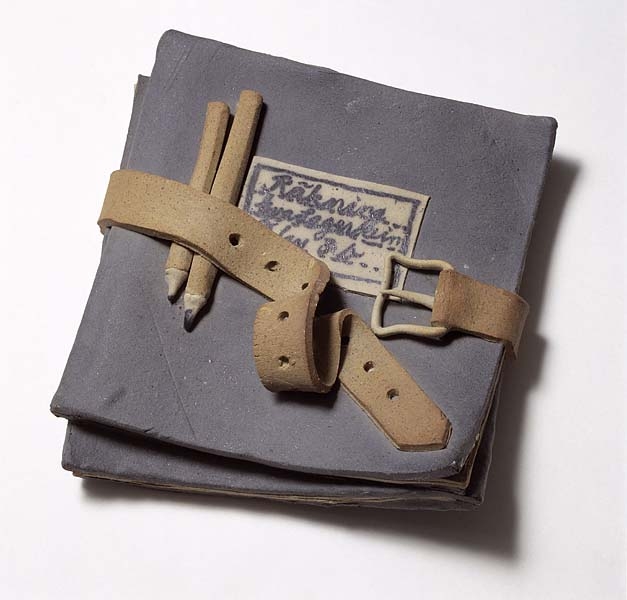
The cover image features Eva Lagerheim’s (1947 – ) sculpture ”Räkneboken” (The Math Book) from Nationalmuseum.