“Gifts are one of the ways in which the pictures that others have of us in their minds are transmitted”, Barry Schwartz has written about the social psychology of gift-giving. Scholars of both anthropology and history have studied how gift-giving can serve to confirm societal power structures as well as how they can be material visualisations of the ties that bind different generations together (for one example of the latter, see our previous post on bequests of jewellery). As Natalie Zemon Davies has noted on early modern gift-giving, gift exchange exists alongside two other relational modes: the mode of sales (buying; selling) and the mode of coercion (theft; forced payment). Historians can’t hope to study wealth without paying attention to the gift as a social practice.
The study of gifts is the study of power. While the GLOW project investigates the wealth of the most powerful families in Swedish society, the sources of concern to the project also intermittently deal with the servants employed by the very wealthy.
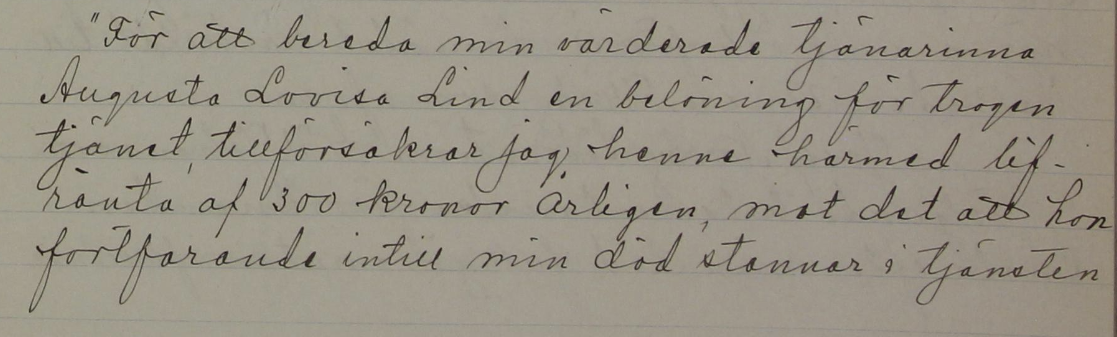
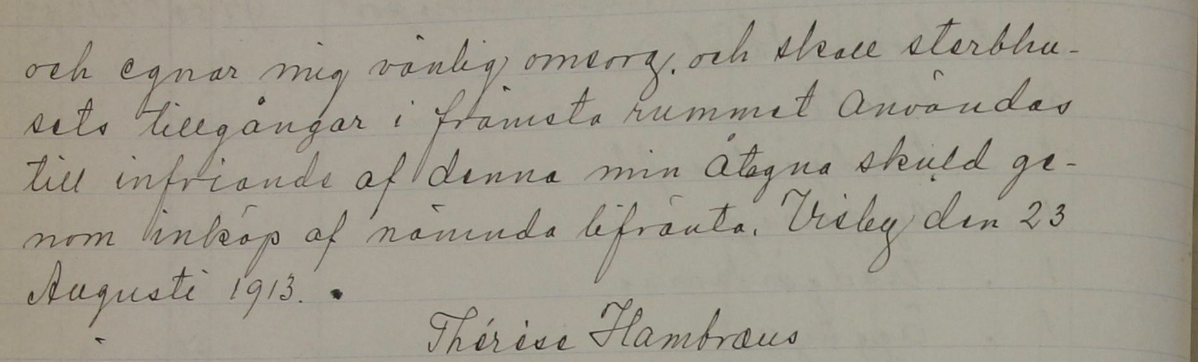
To take one example, Théresé Hambraus’ probate inventory notes a 1913 document stating that she wished to grant to her “treasured servant” Augusta Lovisa Lind a yearly income of 300 SEK, on the condition that Augusta stayed in service until Théresé’s death and provided her with “kind care” (“vänlig omsorg”). The bequest can be understood as a gift in that it was intended to give Augusta a benefit that went beyond her regular wage, and was framed as an expression of personal gratitude and affection. However, the gift was still made on the condition that Augusta would continue to care for her employer. In this way, generosity could reinforce existing obligations and dependencies; the bequest exists in an ambiguous space between gift and payment, and both the gift itself and the language used in the document at the same time indicate a personal bond between the two women and an inescapable inequality. The line between affection and exchange is blurry, to say the least.
In 1925, Hilda von Baumgarten left her servant Elina Andersson a list of household objects, including a sewing table, a bed, cutlery, sheets, towels, napkins, and a set of tableware (the latter items were noted as old and broken (”1 bordsservis av porslin, gammal och söndrig”). The selection of objects indicates the life that she imagined for Elina beyond service: a domestic life, in which she may make her own clothes, perhaps receive guests in her own household. The bequest did more than transfer material possessions; it also conveyed an image of the recipient and of the future life that Hilda envisioned for her. The objects tell us something about how she imagined Elina’s needs and circumstances, but not necessarily about how Elina thought about her future.
A year later, Elina had moved to Helsingborg, and she continued to be the recipient of the von Baumgarten family’s generosity. Hilda’s brother Thure Reinhold Leonard von Baumgarten, who died that year, instructed one of his late wife’s relatives to ensure that the relative gave Elina an obligation worth 1000 SEK, in addition to ensuring that the former servant received a yearly payment of 75 SEK. This raises questions about what kind of relationship Elina really had with the von Baumgarten family, who seemed to genuinely take an interest in her financial future. The siblings, who both died without children, might have thought of Elina as a substitute for a daughter.
In 1881, Sofia Maria Fagerlund left a small cottage adjacent to a larger farm, 2000 SEK in cash, and an unspecified share of her movables to her ”old servant” and maid, Sara Christina Nilsdotter. If Elina’s bequest hinted at an imagined future beyond service, Sara’s employer might have been trying to provide for her servant’s later years. In both cases, the gifts reveal how employers imagined and sought to shape the lives of those who had served them. In these reflections of the perceived needs and wants of these women, we catch a glimpse of the people who spent their lives attending to the material needs of the wealthy. Looking at the gifts they received allows us to shift our attention from those who accumulated wealth to those whose often-unseen labour made such wealth and lifestyles possible.
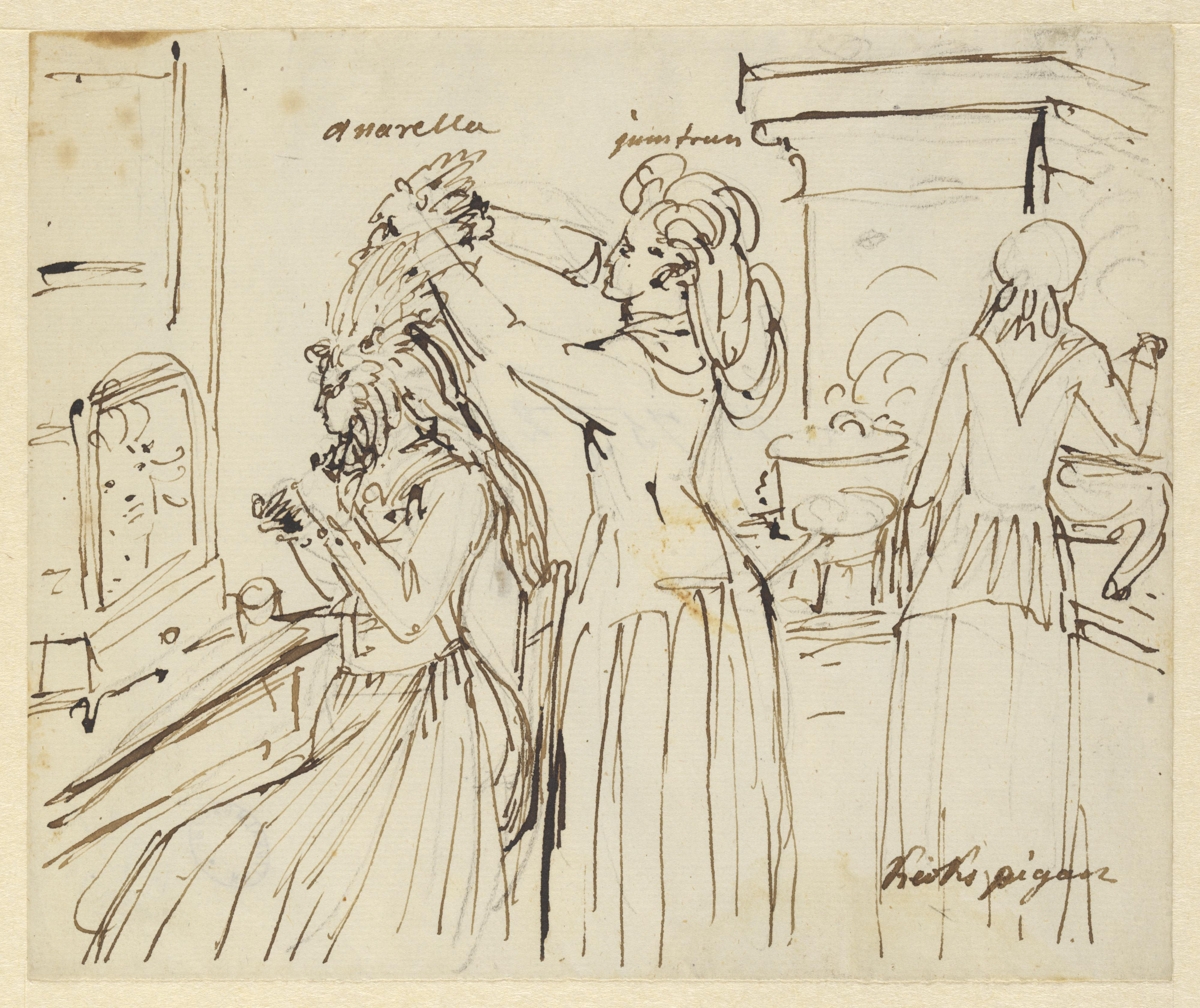
The cover image is Johan Tobias Sergel’s ”Anna Rella låter jungfrun kamma sig medan kökspigan lagar mat” from Nationalmuseum.