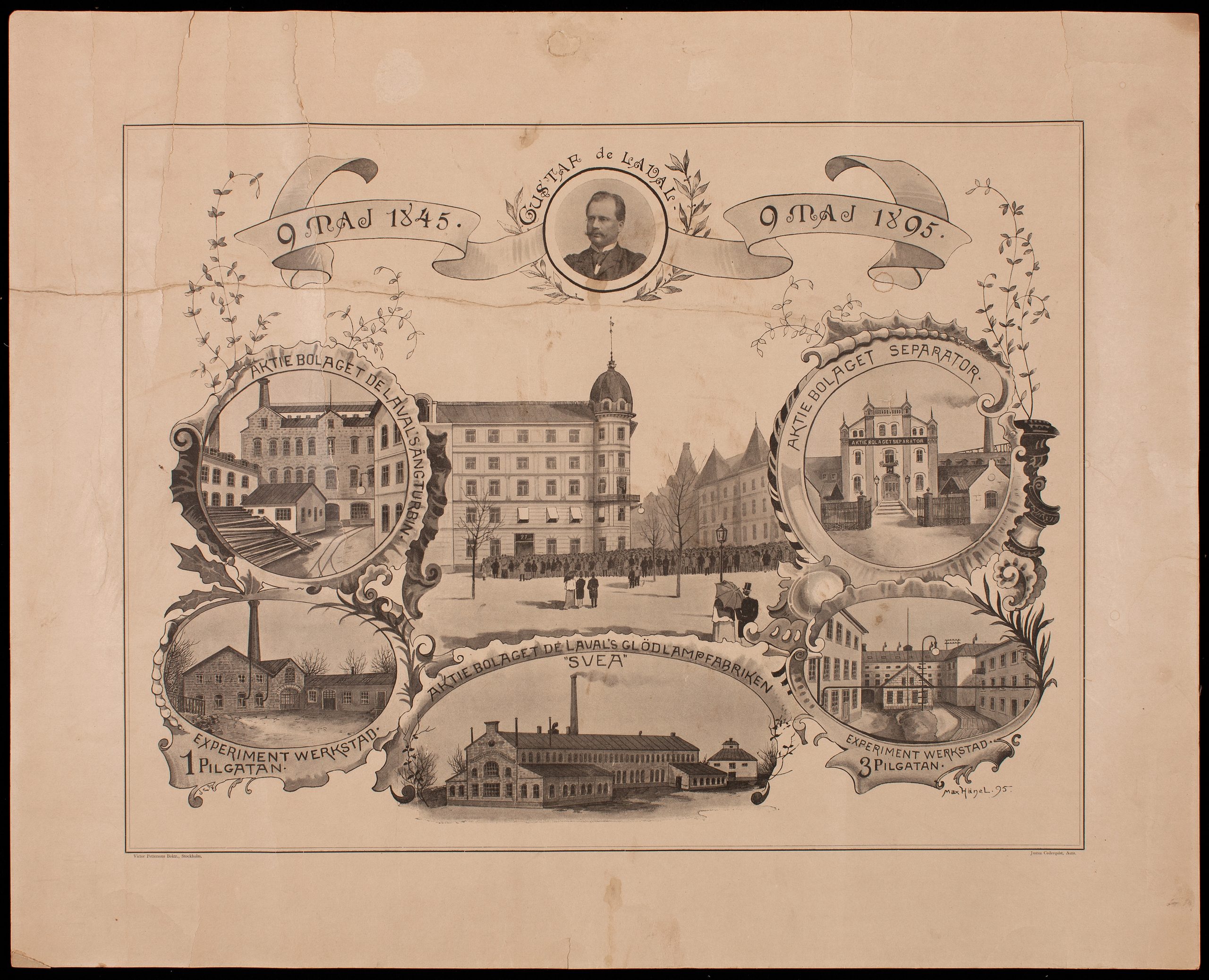
What connects milk and cream with one of Sweden’s best-known industrial engineering companies?
The answer to this question is the de Laval family – and an inventor who was much better at making machines than at managing his own money.
The Swedish story of the de Lavals began long before industrialisation. Claude de Laval, born in France in the late sixteenth century, arrived in Sweden in 1622, pursued a successful military career and was ennobled in 1646, establishing the de Lavals among Sweden’s untitled nobility.
Over the following generations, the family produced soldiers, officers, engineers and entrepreneurs. Yet the de Lavals were never one of Sweden’s great landed dynasties. Before industrialisation, this mattered: land was the main component of elite wealth, and large estates gave families an obvious advantage when it came to passing fortunes from one generation to the next.
The de Lavals followed a different path. Much of the wealth that appeared in the family during the nineteenth and early twentieth centuries was not simply inherited. It was created – and increasingly it took the form not of estates and farms, but of shares.
A man obsessed with speed
The turning point came with Carl Gustaf Patrik de Laval (1845–1913). Born in Dalarna, he studied engineering and chemistry before working in Swedish ironworks. There he turned his attention to a rather everyday problem (at least back then): how to separate cream from milk more quickly.
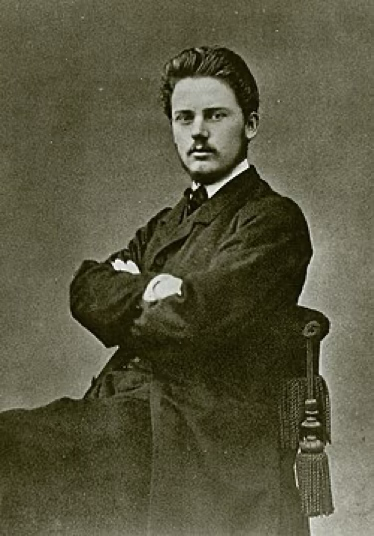
Gustaf de Laval in 1875. Wikimedia Commons, https://commons.wikimedia.org/wiki/File:Gustaf_de_Laval_1875.jpg.

Traditionally, milk was left standing until the fat rose to the surface and could be skimmed off. De Laval realised that centrifugal force could do the job much faster. In 1878, he and his business partner Oskar Lamm patented a centrifugal separator. The first continuous model, demonstrated in Stockholm the following year, could process around 130 litres of milk an hour.
In 1883, he and Oskar Lamm founded AB Separator to manufacture and sell the machine. Remarkably, that company still exists. AB Separator became Alfa-Laval in 1963, “Alfa” referring to the Alfa discs that improved the separator’s efficiency, and “Laval” to its inventor. Today Alfa Laval is a global industrial group working in separation, heat transfer and fluid handling. In 2025 it employed more than 23,600 people and had sales of SEK 69.6 billion. Not bad for a business that began with getting cream out of milk.
Milk was only one of de Laval’s interests. He worked on steam turbines, pumps, milking machines and electric furnaces, among many other things. Over his lifetime, he registered 92 Swedish patents and founded 37 companies. One of his most important inventions was a high-speed steam turbine, capable of 30,000–40,000 revolutions per minute. In 1893, AB de Lavals Ångturbin was established to exploit the technology. It later merged with STAL in 1959 to form STAL-LAVAL, an important name in Swedish power engineering.
A brilliant inventor – and a terrible investor
There was, however, a problem. Gustaf de Laval could create companies; keeping the resulting fortune was another matter. The contrast with another, even more celebrated Swedish inventor, Alfred Nobel, is hard to miss. Nobel, one of the most famous nineteenth-century inventors, died in 1896 leaving more than SEK 31 million (SEK 2.5 billion in today’s money), most of which was used to establish the Nobel Prizes. De Laval’s story ended very differently.
Money from successful inventions disappeared into new experiments and ambitious projects. Debts accumulated and several ventures failed. When he died in 1913, his estate was effectively bankrupt. A notice in Svenska Dagbladet on 21 February reported assets of just SEK 786.95 against debts of SEK 146,893.61. His widow, Isabel, had to surrender the estate to the creditors. This probably also explains why we were unable to find his probate inventory: it may have formed part of the bankruptcy proceedings.
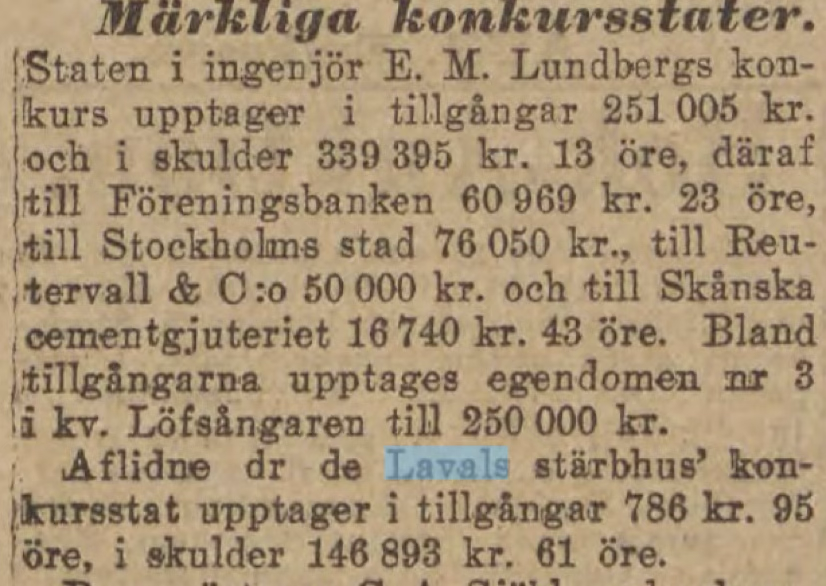
A notice in Svenska Dagbladet, 21 February 1913, reporting Gustaf de Laval’s bankruptcy estate: assets of just SEK 786.95 against debts of SEK 146,893.61.
When Isabel died in 1956, her gross assets amounted to only about SEK 3,500 – roughly SEK 60,000 today. De Laval had not left anything resembling a great fortune to his immediate household.
But other de Lavals did much better. Gustaf’s younger brother Anders Jakob Roland de Laval (1847–1899), an army officer, provides a striking contrast. His probate inventory, recorded in 1900, listed gross assets of SEK 730,000 – roughly SEK 52 million today, among the richest noble estates recorded that year.
Inheritance matters – but so does what you do with it
This is where Gustaf’s personal story becomes a family story. He may have failed to turn his inventions into lasting personal wealth, but the companies he helped create opened new opportunities for his relatives. Studying the family wealth between 1750 and 1950, we find that shares became increasingly important in de Laval family portfolios. The family’s probate inventories contain holdings in businesses carrying the de Laval name – AB Separator, AB de Lavals Ångturbin and AB de Lavals Glödlampsfabrik Svea – alongside investments in banks, sawmills and paper production.
Not every branch of the family followed the same strategy. Some invested heavily in shares; others put more of their wealth into land. The results diverged sharply. The wealthiest branch invested relatively little in landed property and much more in financial assets. Those who moved most strongly into shares accumulated wealth much faster.
Gustaf de Laval did not become rich and simply pass a fortune to the next generation. Instead, his inventions created companies, and those companies became part of the economic world in which other members of the family invested. The inequalities that developed within the family therefore cannot be explained by inheritance alone. Different branches made different choices: some bought land, some bought shares, and some invested in companies created by one of their own relatives.
The de Lavals are a useful reminder that what families inherit is only part of the story of wealth. What they do with their opportunities matters too. Sometimes one inventive relative can change the fortunes of a family – without ever making much of a fortune himself.
The cover image is a 1895 poster detailing Gustaf de Laval’s companies on his 50th birthday. Source: Tekniska Museet.