“What DNA is to the physical body, processes of succession are to society – that is, to the social body. An elite, an upper class, is a class that inherits”
— Lawrence Friedman, Dead Hands (2009)
Inheritance is one of the most powerful mechanisms through which wealth, status, and opportunities are transferred from one generation to the next. Yet despite its importance, inheritance has often been treated as a private family matter rather than as a major force shaping society.
Over the last decade, this has started to change. Following Thomas Piketty’s Capital in the Twenty-First Century and its emphasis on the renewed importance of inherited wealth, scholars, policymakers, and the wider public have become increasingly interested in the role of inheritance. Today, attention is focused not only on the present but also on the future, as wealthy baby boomers begin to pass on unprecedented amounts of wealth. This so-called ”Great Wealth Transfer” has led some observers to argue that we are entering an age of inheritocracy, in which parental wealth increasingly outweighs meritocratic ideals, education, and labour in shaping life chances. Closely linked to this is the question of inequality: if inherited wealth plays a growing role in determining individual outcomes, rising economic inequalities are likely to be transmitted to future generations as well.
While inheritance is becoming more important in contemporary debates, there are good reasons to turn to history. Historians bring something distinctive to these discussions: a long-term perspective. Historical research allows us to ask whether current developments are genuinely new or whether similar dynamics have existed before. It helps us identify both change and continuity, and places today’s concerns in a broader context. There are many reasons to study inheritance historically, but three stand out.
First, inheritance shapes life chances. Analysing the role of inheritance thus helps us understand how opportunities and inequalities were structured in different societies. If inheritance strongly influenced the destinies of younger generations, then it played a fundamental role in shaping social hierarchies and economic outcomes. If, on the other hand, work, entrepreneurship, or education were more important, this would suggest a different social order. The relative importance of inheritance has varied across time and place and has been shaped by gender, class, legal institutions, and economic development. Understanding these variations is essential for understanding how past societies functioned.
Second, inheritance practices change over time. Succession does not always work in the same way. Wealth transfers are shaped not only by legal frameworks but also by social norms, cultural values, and economic circumstances. Historical studies reveal how families adapted their strategies in response to changing conditions. Industrialisation, urbanisation, demographic change, and legal reforms all influenced how wealth was passed from one generation to the next. By examining wills, probate records, tax records, and contested transfers, historians can trace how families responded to these transformations and how their decisions affected the distribution of wealth.
Third, inheritance is a contested institution. It has never been only about money: throughout history, people inherited land, businesses, social networks, titles, knowledge, and cultural resources. Inheritance systems reflected broader social values and political priorities. Debates about inheritance have therefore often been debates about fairness, opportunity, incentives, and the relationship between individual rights and the common good. At different times, inheritance has been viewed either as a natural and desirable institution or as a source of social problems requiring regulation and taxation. By studying inheritance historically, we can better understand how different societies have grappled with enduring questions about fairness, opportunity, and the legitimacy of inherited wealth.
In all three respects, inheritance provides a unique window into the relationship between families and society. Families are often viewed as private institutions, yet inheritance demonstrates how closely family decisions are connected to wider economic and political systems. Questions about who inherits, how much, and under what conditions have implications for social equality, economic growth, and political power. Studying inheritance therefore helps historians understand not only how wealth was transferred, but also how societies reproduced themselves across generations.
At HEIRS, several research projects explore these questions. Most notably, the GLOW project investigates the practical role of inheritance and wealth transfers across multiple generations within very wealthy Swedish families. By tracing the long-term development of family fortunes, the project seeks to better understand how wealth is preserved, transformed, and transmitted over time.
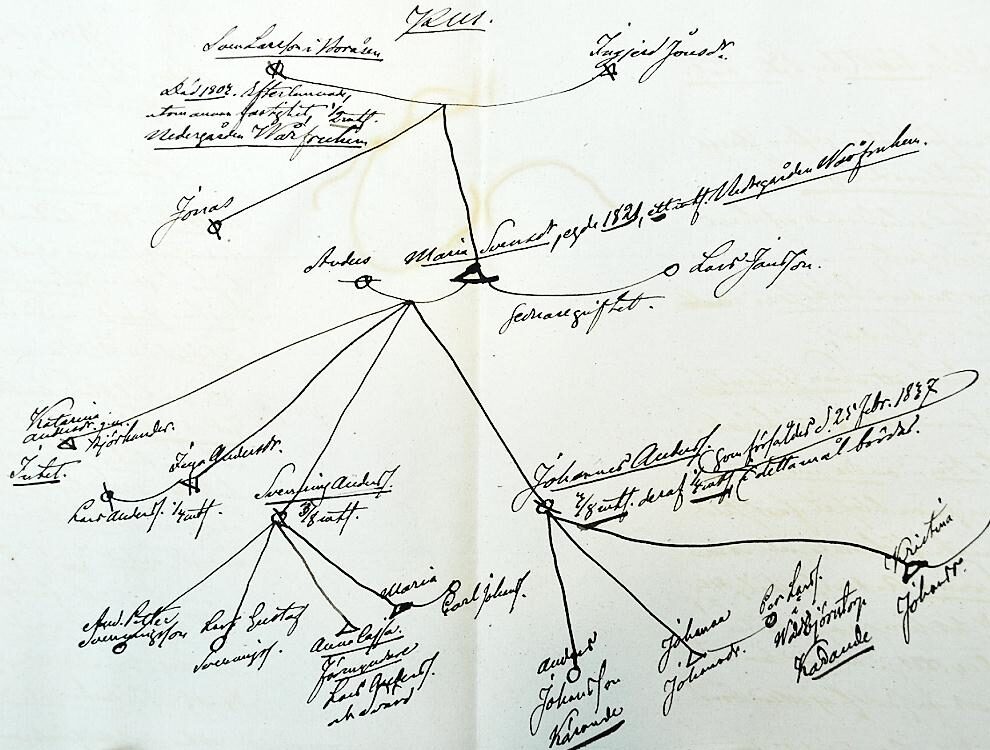
Top image: Diagram showing family relationships and land inheritance in an inheritance dispute (The Supreme Court Archive of Sweden, 1863).